


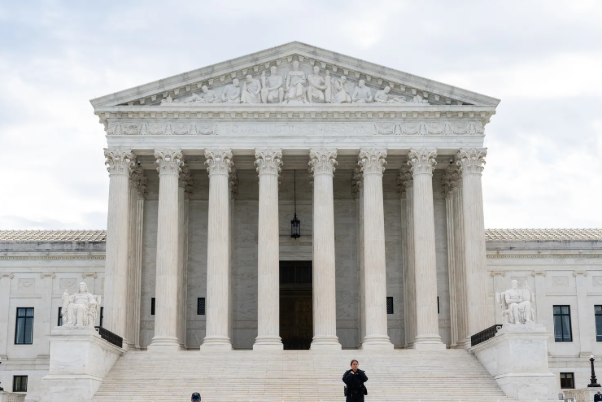
Supreme Court Rejects Virginia Redistricting Appeal
The U.S. Supreme Court on Friday declined Virginia’s request to reinstate a congressional redistricting plan that could have helped Democrats gain four additional seats in the narrowly divided House of Representatives.
The unsigned order, issued without any public dissent from the justices, marks another major development in the ongoing nationwide redistricting fight. The political battle accelerated after President Donald Trump encouraged Republican-led states to redraw congressional boundaries, while a recent Supreme Court ruling weakened key protections under the Voting Rights Act, creating new opportunities for GOP-friendly districts.
In recent weeks, the Supreme Court has supported Republican-backed efforts in states including Alabama and Louisiana to revise congressional maps in favor of more Republican seats following the voting rights decision.
However, the Virginia case followed a different legal path. Earlier this month, the Virginia Supreme Court voted 4-3 to strike down a constitutional amendment approved by voters. The amendment aimed to establish new congressional districts that Democrats believed would improve their chances in future House elections.
The state court ruled that Virginia’s Democratic-controlled legislature improperly advanced the amendment process after early voting for the general election had already begun in 2025. According to the court, that timing violated state constitutional procedures.
Traditionally, the U.S. Supreme Court avoids intervening in state court matters unless federal legal questions are involved. Virginia Democrats argued that the state court misinterpreted federal election law and previous Supreme Court rulings, which generally recognize Election Day rather than the start of early voting as the official date of an election.
Virginia’s proposed amendment was viewed as a Democratic response to Republican-led redistricting gains in states such as Texas, Missouri, North Carolina and Ohio, as well as a newly approved congressional map in Florida. For a short period, the Virginia measure appeared to balance the national redistricting battle between Republicans and Democrats.
That momentum ended with the Virginia Supreme Court’s ruling and Friday’s decision by the nation’s highest court.
Virginia Attorney General Jay Jones criticized the Supreme Court’s refusal to intervene, calling it part of a broader national effort that he says threatens voting rights and democratic institutions.
In a statement released Friday night, Jones accused Donald Trump, Republican-controlled legislatures and conservative courts of reshaping political power for partisan advantage.
State Democratic leaders remained divided over whether there was still enough time for the Supreme Court to step in before the upcoming elections. Attorneys representing Democratic legislative leaders argued in court filings that action was still possible despite looming election deadlines.
Meanwhile, the office of Democratic Gov. Abigail Spanberger confirmed Thursday that Virginia’s upcoming elections will proceed using the congressional districts established in 2021. Virginia Commissioner of Elections Steve Koski previously stated that any court order changing district boundaries would have needed to arrive by Tuesday to meet deadlines for the Aug. 4 primary elections.
Following Friday’s ruling, Spanberger said the decisions by both courts effectively invalidated the votes of more than 3 million Virginians who participated in the April 21 special election.
Follow Dalmar TV on Facebook for the Latest News
