


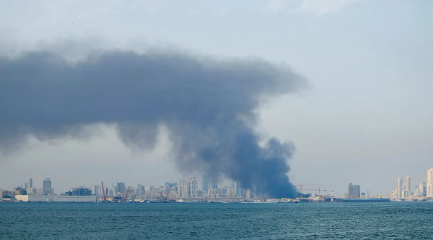
Iran Attacks US Base in Retaliation for US Military Strikes
Tensions between the United States and Iran escalated once again after Iran’s Islamic Revolutionary Guard Corps (IRGC) announced it had launched retaliatory attacks against a US-linked military base following American strikes on Iranian military targets over the weekend.
The latest exchange highlights the fragile state of a ceasefire that has been in place since early April, while negotiations aimed at ending the three-month conflict continue to face significant obstacles.
Meanwhile, President Donald Trump expressed optimism about the prospects of a diplomatic breakthrough, claiming that Iran is eager to reach an agreement with Washington.
In a social media post, Trump urged critics to remain patient, writing: “Just sit back and relax, it will all work out well in the end.”
US Launches Strikes Following Iranian Drone Incident
According to US Central Command (CENTCOM), the weekend military operation targeted Iranian facilities along the country’s Gulf coast. American officials said the strikes were conducted in response to what they described as aggressive Iranian actions, including the reported downing of a US MQ-1 drone operating over international waters.
CENTCOM stated that US fighter jets successfully destroyed Iranian air defense systems, a ground control station, and two attack drones that allegedly posed threats to commercial and military vessels in the region.
US officials emphasized that American forces remain committed to protecting strategic interests and regional stability throughout the ceasefire period.
Iran Responds With Retaliatory Action
On Monday, the IRGC confirmed it had carried out a retaliatory strike against an air base used by US forces. Iranian officials did not disclose the location of the targeted facility.
Reports from Kuwait indicated that air defense systems were activated to intercept incoming missiles and drones, while warning sirens sounded across parts of the country. Kuwait hosts one of the largest US military installations in the Middle East.
The latest exchange mirrors a similar confrontation reported last week, underscoring the continuing volatility despite ongoing diplomatic efforts.
Trump Defends Negotiation Strategy
President Trump avoided directly addressing the latest military developments but reiterated his belief that Iran remains interested in negotiating a broader agreement.
The president also criticized political opponents and members of his own party whom he accused of complicating delicate diplomatic efforts.
Trump argued that conflicting public demands regarding military action and negotiations make it more difficult for his administration to manage one of the most challenging foreign policy crises of his presidency.
His administration remains under pressure to secure greater stability in the Middle East, particularly as rising energy prices continue to impact American consumers ahead of upcoming congressional elections.
Oil Markets React to Ongoing Uncertainty
Global oil markets responded to the lack of progress in negotiations, with crude prices climbing approximately 2% during Monday trading in Asia.
Energy traders remain concerned about disruptions linked to Iran’s influence over the Strait of Hormuz, one of the world’s most important shipping routes for oil exports.
The conflict, which began on February 28, has contributed to increased market volatility and heightened concerns about global energy supplies.
Key Issues Continue to Divide Washington and Tehran
Despite periodic diplomatic contacts, major disagreements remain unresolved.
The Trump administration continues to insist that preventing Iran from developing nuclear weapons remains a top priority. Tehran has repeatedly denied pursuing a nuclear weapons program.
Iranian officials are also demanding the removal of economic sanctions and the release of billions of dollars in frozen oil revenues held abroad.
These issues continue to complicate efforts to reach a lasting agreement between the two nations.
Regional Conflict Adds Further Complications
The broader conflict involving Israel and the Iranian-backed Hezbollah movement in Lebanon remains a significant obstacle to regional stability.
Israeli Prime Minister Benjamin Netanyahu recently ordered military forces to advance deeper into southern Lebanon as fighting with Hezbollah intensifies.
Diplomatic efforts are continuing behind the scenes. US Secretary of State Marco Rubio has reportedly held discussions with both Lebanese President Joseph Aoun and Netanyahu regarding potential pathways toward gradual de-escalation.
At the same time, Israeli forces captured the strategically important Beaufort Castle in southern Lebanon, marking one of Israel’s deepest military advances into the country in decades.
Hezbollah Intensifies Attacks
Hezbollah has continued launching attacks against Israeli military positions and civilian areas in northern Israel.
The group claimed responsibility for multiple strikes targeting Israeli troops and military equipment near the Lebanese border. It also reported attacks extending deeper into Israeli territory, including areas near Haifa and Nahariya.
Israeli authorities said nearly 200 civilian alerts were issued within a 24-hour period due to incoming drones and missiles.
Military officials have also expressed growing concerns over Hezbollah’s deployment of fiber-optic drones, which are proving difficult to detect and intercept.
As hostilities continue across multiple fronts, international efforts to secure a lasting ceasefire and broader regional agreement remain under increasing pressure.